
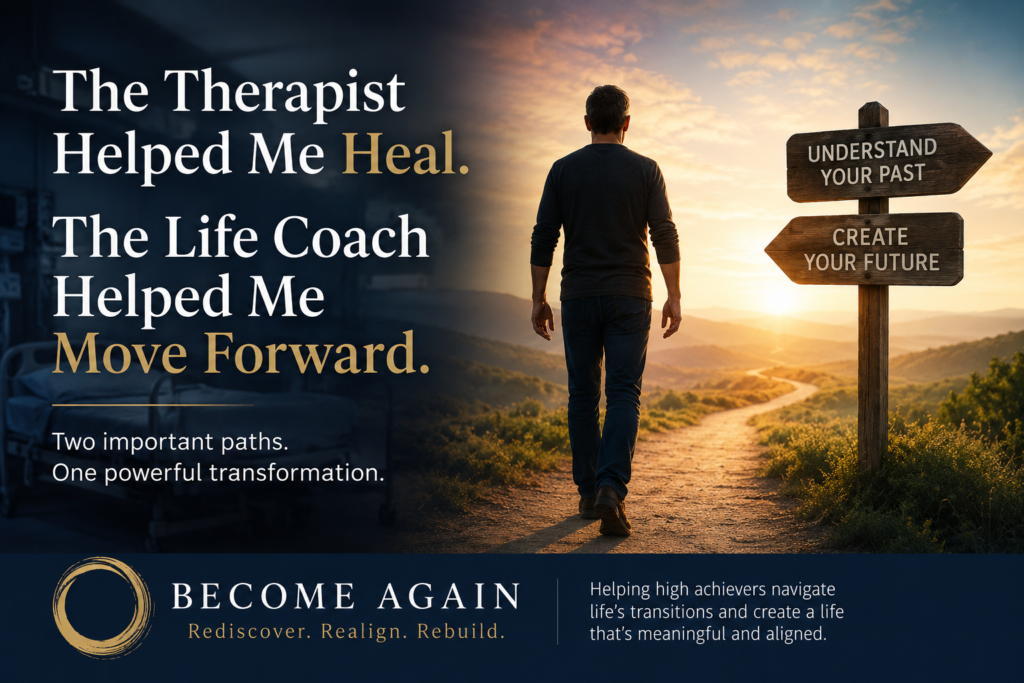
I spent 10 days in a coma rebuilding my identity. What I discovered about therapy, coaching, and creating a meaningful life might surprise you.
When exploring therapy vs coaching, you quickly realize that healing from the past and moving forward into the future aren’t always the same thing.
Years ago, after surviving a catastrophic car accident and spending 10 days in a coma, I found myself rebuilding not only my health but my entire sense of identity. Like many people facing a major life transition, I was trying to understand what had happened, who I was now, and what my future could look like.
That journey introduced me to both therapy and life coaching, and understanding therapy vs coaching showed me how each played a valuable role in my recovery.
Therapy vs Coaching: What Therapy Gave Me
During my recovery, I began working with a therapist, and I’m grateful I did.
Therapy gave me something I desperately needed: understanding.
It helped me process trauma, work through grief, and better understand how my experiences had shaped me. I learned to recognize patterns, explore difficult emotions, and make sense of a life that suddenly felt unfamiliar.
That work was essential.
But eventually, I noticed that a different question was emerging.
I understood more about what had happened to me.
I understood more about why I felt the way I did.
Now what?
The Shift That Changed Everything
When exploring therapy vs coaching, I quickly noticed that the focus felt completely different.
Rather than concentrating on understanding my past, many of our conversations centered on creating my future.
The questions changed.
Instead of asking, “Why did this happen?” I found myself exploring questions like:
- “What do I want my life to look like now?”
- “What matters most to me moving forward?”
- “What is the next step?”
That shift changed everything.
Because after everything I had been through, I didn’t just want to recover. I wanted to create a meaningful life again.
Coaching helped me reconnect with possibility. It helped me establish goals, take action, and move toward a future that felt aligned with who I was becoming rather than who I had been.
Why Coaching Can Be So Powerful
Many of the people I work with today haven’t experienced a coma or a traumatic injury.
But they often find themselves facing a different kind of crossroads.
From the outside, life appears successful. They may have built a career, achieved important goals, and created the life they once wanted.
Yet something feels incomplete.
They feel stuck.
Disconnected.
Restless.
They find themselves asking questions they can’t ignore:
- “Is this all there is?”
- “Why doesn’t this feel as fulfilling as I expected?”
- “What do I really want next?”
This is where coaching can be incredibly powerful.
1. It focuses on creating the future.
Our past matters, and understanding it can be incredibly valuable.
Coaching, however, is primarily focused on helping people move forward. The emphasis is on possibilities, choices, goals, and creating meaningful change.
2. It turns insight into action.
Many people already know what they need to do.
The challenge isn’t awareness. It’s implementation.
Coaching provides structure, accountability, and support so that clarity becomes momentum rather than just another idea.
3. It helps people reconnect with themselves.
A coach doesn’t provide all the answers.
Instead, coaching creates space for better questions.
Often, people already possess more wisdom than they realize. Through reflection, exploration, and intentional conversation, they can uncover answers that feel authentic and aligned with who they are becoming.
Why I Became a Coach
Becoming a coach wasn’t a departure from my story. It was a continuation of it.
My recovery taught me that major life transitions often force us to confront deeper questions about identity, purpose, and fulfillment.
I’ve learned that the goal isn’t always to get back to who you were.
Sometimes the opportunity is to become someone new.
Today, through my coaching practice and my work at Become Again, I help people navigate those moments of transition. Whether they’re recovering from a significant setback, questioning the life they’ve built, or simply sensing that they’re capable of more, my goal is to help them find clarity and take meaningful action toward the life they want to create.
If you’re feeling stuck, disconnected, or uncertain about what’s next, you’re not alone.
To learn more about my coaching approach, resources, and the work I do helping people navigate life’s major transitions, visit Become Again.
You don’t need to have everything figured out.
You just need to be willing to ask one simple question:
What’s next?